Let us jog back to March 2020, when COVID-19 unleashed its fury across the world. It was period of peak pain. However, we saw something unprecedented, not just households and neighbours, even in the otherwise hard-nosed corporate world health took precedence to profit-seeking. It became a period of peak Empathy!
What is empathy
Cambridge dictionary defines empathy as “the ability to share someone else’s feelings or experiences by imagining what it would be like to be in that person’s situation”
Capitalism resulted in a mass of humanity rising out of poverty, yet it has its faults. Profitable Growth becomes the sole metrics for resource allocation. Failure to meet ambitious quarterly targets in a VUCA (Volatile, Uncertain, Complex, Ambiguity) world has dire valuation and reward consequences. Capital allocators are constantly seeking Alpha; avg period of stock holding in USA by Mutual Funds is now down to 5.5 months from 8 years half a century back. Leadership behaviours (source: LinkedIn) most in demand through the past 25 years have been hard skills; command and control, negotiation, analytics, web architecture and like.
The Times They Are A-Changin! Bob Dylan.
The irony is that we needed Artificial Intelligence (AI) to bring Human Capital to the forefront. Rising Skills of 2026 (LinkedIn) now includes the “Human Trio” of Communication, EQ and Empathy. Active Listening (a key empathy skill) is now the top skill searched by recruiters.
How do we build empathy
Empathy is neither a physical characteristic nor personality trait, it is a cognitive process and can be nurtured. While on surface it could seem challenging the heartening aspect is humans are born with capacity to empathy
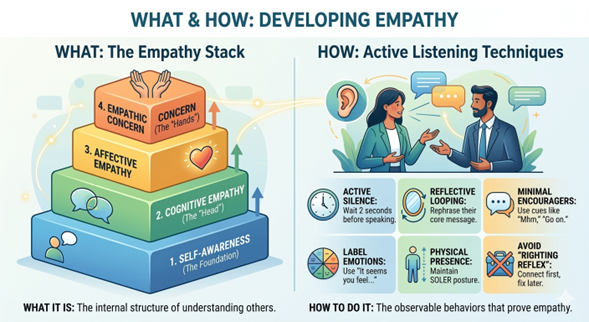
The ‘What’ of empathy involves
- Self-awareness (foundation): a wide emotional vocabulary enables appropriating nuance for self and hence for the other
- Cognitive Empathy (head): this is prospective taking, ie. our mental faculties to be able to in a non-judgemental way figure out basis for others feeling
- Affective Empathy (heart): this is being able to feel a shadow of others emotion
- Emphatic Concern (hand): this is moving toward actions to help overcome the feelings.
The ‘How’ of empathy is about Active Listening. Active listening requires mental discipline (curiosity, avoid Righting reflex etc) and physical presence. A common framework is the SOLER method:
• S: Squarely face the person
• O: Open posture (avoid crossed arms)
• L: Lean in slightly to show engagement
• E: Eye contact (maintained but not intense)
• R: Relax to avoid making the other person feel pressured
Remember, without active listening, empathy is invisible, and without empathy, active listening is just a mechanical interrogation.
The future-ready leader
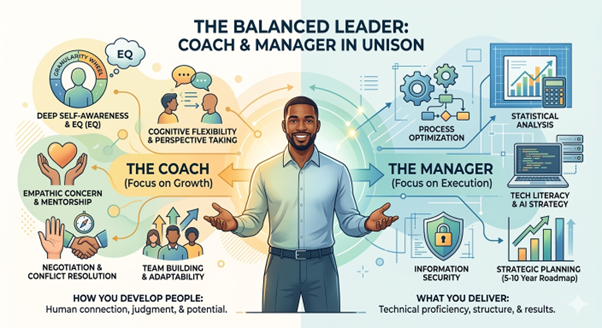
The now famous turnaround of Microsoft by Satya Nadella in 2014 had at its heart empathy. Satya presented to his leadership the book “Non-Violent Communication: A Language of Life”. He argued and demonstrated that to innovate one needs to first understand the unmet and unarticulated needs of the customer – this requires deep empathy. And what an outcome; Microsoft market capitalization rockets from $300bn to $3tn in 10 years.
As we progress from the Internet Era to the AI Era, it behoves a successful leader to be as much a coach as a manager.
Author Name: Neelesh Talathi