I chose the topic of leadership to write my blog for CTT as part of my ICF Level 1 certification. I will answer 3 questions in this blog –
1) What is leadership
2) What competencies make a leader effective
3) How to inculcate those competencies to be an effective leader.
This will be helpful for career starters, managers, leaders at crossroads in their leadership journey, leaders who want to enhance their effectiveness, leadership trainers and coaches.
In my professional career of 29+ years I was fortunate to have worked with some leading employee brands in the world viz – Procter & Gamble, Shell, Reliance Industries, Walmart and Amazon. I worked as a sales executive, business development officer, operations manager, trainer, training manager, learning & development leader, organisation development leader, recruitment leader and HR Transformation leader. Each of these tenures provided some unique learning that helped me grow my knowledge of leadership. It helped challenge my biases and add new perspectives. I observed leaders of different types – introverts, extroverts, communicators, thinkers, analysts, visionaries, managers, influencers, realists, optimists, etc. My experience has taught me that there is no one single formula that makes a person a leader. It is a vast topic on which several books are available in the market. I am going to focus on some aspects of leadership that I observed and I was inspired by. My definition of leadership is not from a book but from my own experience. I have understood Leadership as a competency that enables leaders to create a vision, take appropriate decisions and influence others to partner with them to achieve it.
My first proper job started in October 1995 with Procter & Gamble (P&G) Godrej as a Sales Officer. In 1998 P&G and Godrej announced their separation. There was a new National Sales Head for P&G, a young leader educated in Wharton and with 8 years’ experience. He proposed a radical idea of distribution that will position P&G as a premium brand and improve shareholder value (which was their vision at that time). The Indian market relied on the traditional model of pushing high inventory into the retail to block competition. His idea was to reduce this inventory and achieve more inventory turns by ensuring more efficient supply chain. He wanted to strengthen the marketing and create a pull in the retail channel by focussing on few, premium, global SKUs. This would integrate P&G India into the global strategy. This required doing away with the most of the existing sales force and distribution channel. Hundreds of young and old sales officers were “offered” voluntary retirement as their capabilities did not match the new strategy. Thousands of stockists with decades old relation with the company were asked to quit. SKUs were discontinued and prices for rest were increased multiple times within just 2 years. There was high level of scepticism among experts who felt that the young leader was acting in haste without understanding the Indian market. However, the young leader provided a compelling vision to his stakeholders. He led the organisation on an unchartered path with few supporters. This strategy succeeded and eventually P&G India integrated itself with the global organisation to position itself as a FMCG company for the premium global customer. P&G cut its losses, improved margins, and the share prices multiplied.
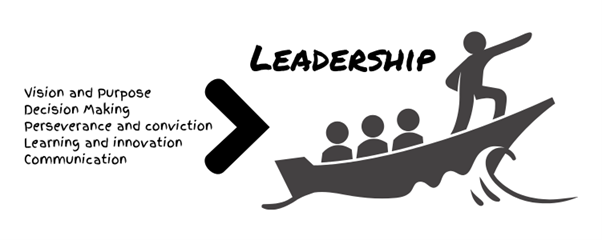
The journey of a leader starts with their vision and purpose. One cannot be a leader if they cannot visualise and express the end state and their purpose in an inspiring and compelling way to get followers. The characteristics of a good vision is its simplicity and impact. Both visualisation and communication are key competencies. A successful leader is a good story teller who can weave story around their vision. The leader should demonstrate clarity of thought that makes their ideas simple to understand and relate to. The simplicity demonstrates clarity of thought and is achieved through a process of thinking through details, articulating and seeking feedback multiple times. Sometimes a leader may not have their own vision but they may construct a vision by partnering with others. In order to set up a good vision the leader needs to answer why am I doing what I want to do? What will be its impact on myself, my partners, stakeholders, and world at large? Why is this important to achieve? What will happen if we don’t do this?
A leader is expected to take decisions that deal with risks and sometimes intentionally make bold bets. Their decisions are based on knowledge, experience and acumen. For example, Jeff Bezos’s, founder of Amazon.com, idea of selling books through internet was not based on any data. He decided to leave his job and put all his and his wife’s investment into the idea based on his instinct. Before taking the decision, he met multiple publishers and sought their opinion about his idea. Successful leaders seek and listen to lot of advice and feedback. They also collect and analyse as much data as possible but eventually they rely on their instinct to decide. They need the ability to rely on their instincts in absence of relevant data. One can strengthen their instinct by having a good knowledge of their customer and developing an ability think on behalf of the customer. It is important to place oneself in a customer’s position and take a decision as a customer. Tools like design thinking can also be used when conviction in good instinct is low.
Many times, leaders themselves may not have the complete picture of how their vision will evolve or what surprises the path will surface. What they have though is absolute conviction and unshakeable desire to achieve the vision. A successful leader always looks out for imminent and potential risks and ways to mitigate or work around them. Leaders recognise failures as setbacks and then find alternate ways to achieve their vision. In fact, they would love to fail fast so that they can put behind the failures and learn from experience as early as possible. Sam Walton, founder of Walmart started his retail journey with a franchise store. His vision was to provide customers the best merchandise at lowest cost every day, closer to their homes. His decisions helped the store become the largest grossing in their franchise. This caught the attention of the franchise owner who decided to own the store directly and cut off Sam from the franchise. This was a big setback for Sam. His conviction in his vision was unshakeable, he took this as a learning and started his own store – Walton’s 5-10. How Walmart became world’s largest company and redefined the retail business is known history now. Leaders need to demonstrate perseverance, unshakeable conviction in their purpose and vision. Focussing on the vision, purpose and the impact the leader wanted to create helps in building perseverance.
Leaders cannot succeed with their ideas set in stone. Successful leaders demonstrate an unsatiable curiosity to learn and be extremely humble to seek learning out of every experience. They have to be aware of their biases and work around them to always absorb learning. Humility, curiosity and adaptability are important skills for leader to be able to learn continuously. Learning feeds innovation and innovation helps a leader keep up their competitive spirit. Innovation is also very important to keep the team engaged and focussed on the vision. The leader also has the responsibility to establish a culture of innovation and learning in their team. They themselves may not be able to absorb all the learning come up with all the new ideas. A learning culture in the team helps their team to share learning and support each other’s innovative ideas. The purpose of learning for a leader is to challenge their existing understanding and seek ways to be more effective in achieving the vision. A leader should ask themselves what have they learnt in the last one year and how they changed their perspectives. If they haven’t added a new skill in one year then should recognise that they are becoming stale. If they have not changed their perspective about their purpose or vision in the last one year then they should realise that they have not discussed it enough.
It is a common misunderstanding that leaders need to talk a lot. Actually, leaders need to ALWAYS listen a lot, and then speak in a way that earns them trust. If you reflect back on leaders whom you respect you will agree that they were good listeners. They should also know what to communicate. Successful leaders always have a very high level of empathy which is demonstrated in their communication. Even when they are communicating to a large group, they are able to empathise with their feelings. They realise that effective communication starts and works backward from the customer. If one is not a natural communicator the best way to start is to write down the message from the audience perspective, get feedback from multiple people and also give enough time for making changes before finalising.
Most experts define leadership in the context of leading people to achieve an outcome. However, my own experience is that leadership is not only about motivating other people to achieve an outcome. It is about taking the initiative, taking tough decisions. I have seen that in the traditional organisations which are hierarchical and top-down managed, leadership is about motivating people to achieve an outcome. In the new age industries which are more decentralised, innovation driven and flat in their decision-making process leadership is closer to how I define it. Over a period of time this may combine and leadership will include both the ability to take initiative, drive innovation, and motivate people to achieve an outcome.
Author Name: Bharaniram Bhaskarbhatta
Title of the Blog: Leadership – My experiences
About the Author (a short description of yourself):
Bharaniram Bhaskarbhatta is a Learning & Organisation Development expert with 29 years of experience. He is a coach, consultant and motivational speaker supporting individuals and small organisations leverage the experience gained in large multi nationals. His experience includes Sales, Business Development, Operations and Hiring. He is also an expert in Retail and FMCG distribution.
Program Attended with CTT: ACC
Reason for taking this program: ICF Credentialing
What worked for you: The support I got from the mentor coach, the feedback he gave, the advice he gave were very valuable and helped to change.
What benefits you got: This program helped me to reflect on my coaching abilities and work towards fixing improvement areas.