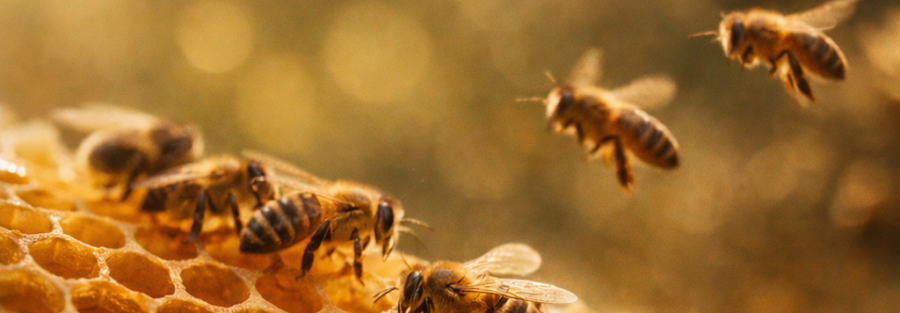
My curiosity for this inquiry did not begin in theory. It began in the quiet hum of a beehive.
I started beekeeping in 2017 as a hobby, seeking a place where I could place my energy into something life-giving. A space to give back to nature and to be useful when I had time on my hands. Honey was never the true reward.
The unexpected gift was observing a living system functioning with rhythm, intelligence and balance. Over time, as my own leadership journey and coaching practice evolved, I began to notice parallels between the hive and the organizational ecosystem in which I was growing as a leader.
Bees thrive through adaptation and contribution to the whole, not through control or individual ambition. Within a hive, learning happens through participation. A bee begins life with contained responsibilities inside the hive before gradually moving outward as readiness and the needs of the hive align. Development is not forced; it unfolds in response to context.
This challenged how I understood growth in human systems.
In many organizational and coaching contexts, development is framed through goals, milestones and visible progress. These structures are useful, yet they can subtly reinforce the belief that growth must be accelerated and individually owned. The hive offers another lens: development as relational, contextual and responsive.
My own professional journey mirrors this rhythm.
My movement from direct operational work to advisory roles was gradual. I was learning, observing and contributing within the system. However, my transition from advisory into leadership was catalytic. I suddenly carried responsibility for the performance of an entire function across geographies. I was not formally prepared. I led largely from instinct.
What I did have was awareness. I observed pace, personalities, pressures and context. I sensed what the system required and committed to bringing curiosity, openness and balance into each space. Leadership became less about authority and more about alignment.
It was here that coaching shifted from being a tool to becoming a way of being.
Owning the performance of the whole required me to release control. I could no longer rely on personal effort alone. I had to trust others to bring their best selves forward and remain accountable to their commitments. I needed to create clarity, safety and shared ownership. I learned to hold people accountable in ways that felt empowering rather than constraining. I defended when needed, gave feedback honestly and embraced mistakes as part of growth within context.
My identity shifted. Leadership became less about directing and more about enabling contribution. My pace changed too. Development could not be rushed. There were always factors, relationships and context influencing each stage of growth. Most significantly, I began to see my role as returning power to others: enabling them to shape their own narrative within the organizational ecosystem.
The hive reflects this wisdom.
Within a colony, contribution is fluid and non-hierarchical. Every role serves the wellbeing of the whole. Intelligence is distributed. No single bee directs the hive; decisions emerge through collective sensing and responsiveness to environmental cues.
This resonates deeply with the coaching stance. Insight does not reside with the coach. It emerges through presence, deep listening and trust in the client’s internal and systemic wisdom. Coaching becomes less about problem-solving and more about creating conditions where awareness can surface.
The hive also teaches rhythm. There are seasons of expansion and seasons of consolidation. Activity and rest coexist. Growth is cyclical, not linear. In contrast, many human systems prioritize constant momentum. Pauses are often interpreted as stagnation rather than integration.
Viewing coaching through an ecosystem lens invites a different relationship with these moments. It suggests that pauses may support recalibration and readiness for new forms of contribution. The coach’s role becomes one of sensing, knowing when to inquire, when to remain silent and when to allow space for emergence.
One of the most striking lessons from the hive is how contribution is valued. Success is not defined by status or visibility, but by alignment with the needs of the system. This challenges coaching conversations that unconsciously prioritize personal achievement over systemic wellbeing.
An ecosystem-informed lens expands the inquiry: How does your growth serve the whole? Where does your contribution strengthen the system that you inhabit? Coaching, from this perspective, moves beyond self-optimization toward relational purpose and shared impact.
These reflections have subtly reshaped my own practice, particularly as learnt through my PCC credentialing journey. I listen less for immediate solutions and more for signals of readiness. I attend to what is emerging beneath stated goals. I slow the pace when needed, trusting that insight surfaces when conditions are supportive. Action remains important, yet it becomes an outcome of alignment rather than the driver of change.
From a coaching knowledge-building perspective, this inquiry does not propose a new methodology. It offers a lens. By drawing from living ecosystems, coaching can deepen its understanding of development as interdependent and adaptive. In increasingly complex organizational environments, this systemic awareness feels essential.
This reflection opens questions worthy of further exploration: How might coaching frameworks intentionally integrate principles of distributed intelligence and sustainability? What would it mean to evaluate coaching impact not only through individual goal attainment, but through measures of collective health and resilience? As leaders navigate uncertainty and interdependence, how might coaches strengthen their capacity to work with emergence rather than control?
Standing beside a hive, listening to its steady hum, I am reminded that nature does not rush. Yet everything unfolds.
Perhaps coaching, at its most mature, mirrors this truth. When presence is steady, when trust replaces control and when readiness is honoured over urgency, development emerges as aligned, empowered and sustainable.
And maybe, like quality honey, great performance or sustained success or transformation is simply the by-product of a healthy ecosystem at work.
Author Name: Jennifer Gichohi
PCC credentialing Journey (CTT)