
Coaching as a journey for me has been interesting since the start back in March. While I learnt a lot, it felt superficial at times. When I started the ICF PCC journey, demands were on “Depth”. I failed to find the depth of the craft inside me. And then something shifted.
Throughout my ICF ACC journey, coaching sat comfortably inside the domain of psychology. It is described as a process of improving behaviour, shifting mindsets, rewiring beliefs, building habits, and setting goals. I found it insightful but incomplete, which led me to search for the Philosophical roots of Coaching.
This search made me realize that coaching is much older than the field of psychology. The questions that we deal with as coaches: What do I truly want? Why do I feel stuck? How should I act? What is the right next step? are not psychological alone. At the core, they are philosophical questions.
We humans have asked these questions long before coaching frameworks, models, and certifications appeared on the horizon. Ancient thinkers across cultures explored topics like purpose, agency, suffering, and attachment. The same topics surface in coaching conversations frequently.
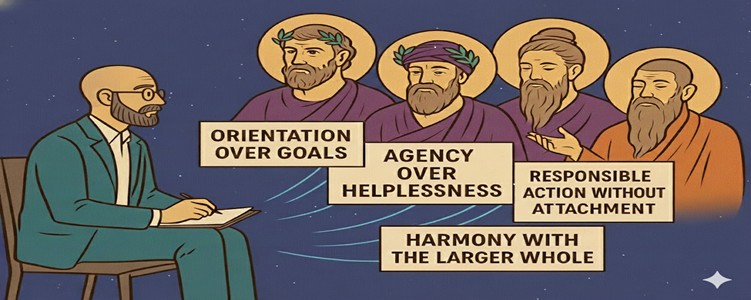
In the last few weeks, the following 4 philosophical dimensions have emerged as pillars of coaching for me.
1. Orientation over Goals
Novice coaches put enormous emphasis on goal setting, i.e., milestones, action plans, and targets. Yet experienced coaches know that clarity doesn’t emerge from perfecting goals but by understanding “What makes these goals important”. While targets give a feeling of movement, orientation gives a deeper sense of direction.
Aristotle’s philosophical enquiry was about Telos, the purpose. When a client says ” I don’t know what I want”, they are not seeking a checklist but a compass. Ancient Indian wisdom looked at this from a different angle. Upanishads emphasized our perceptions, i.e., the lens through which we see the world, shapes our choices. In coaching, this comes as simple yet powerful questions.
“What else could be true?”
“If you changed the way you looked at this, what changes?”
2. Agency Over Helplessness
A recurring theme in coaching is clients feeling helpless. People attribute their struggles to bosses, roles, systems, family expectations, or market forces. They feel their life is being shaped by everything except their own choices. Stoics centuries ago emphasized that we should focus on what is genuinely in our control, not what is happening around us or being done to us.
This shift from helplessness to agency, when it happens, one sees that clients stop living reactively. Their actions become deliberate. They feel they are in control. The breakthrough that happens is rarely dramatic. It is quiet, reflective & deeply human.
3. Responsible Action Without Attachment
Modern culture rewards intensity, ambition, and relentless striving. It also breeds anxiety, self-judgment, and emotional overinvestment in outcomes. Instead of achieving targets, targets start owning us.
The Bhagavad Gita teaches nishkama karma. This is not detachment from action but detachment from emotional dependence on outcomes. Work with full commitment, but don’t allow the result to define your worth. Buddhism talks about “clinging,” holding on to a desire or a fear or an experience too tightly.
When I bring these ideas into coaching with questions like –
“What becomes possible if you pursue excellence without fear?”
“If the result didn’t define you, how freely would you act?”
I can see clients loosen up, beginning the process of letting go
4. Harmony With the Larger Whole
Many times coaching starts with self-improvement, but as one peels the layers, one discovers greater philosophical dilemmas about navigating through roles, relationships & living organisms called organizations. The misalignment between the inner self & outer context.
Confucian philosophy emphasised this deeply: wisdom is the ability to act in alignment with both inner intention and outer context. These dilemmas surface with questions like
“How do I stay true to myself while fulfilling the role I hold?”
“How do I fit into the system without losing my centre?”
In coaching, harmony emerges when a person sees their life not as a set of competing obligations, but as an ecosystem.
A Live Example
One of my recent coaching conversations brought these pillars to life. The client, a senior leader, was feeling stuck. Stressed out for a promotion, a family that needed attention & a very demanding boss made her feel helpless. She wanted “next steps” & “to-do list”; she went back with something very different.
Orientation over Goals – At first, the client obsessed with role, title, pay. But when I asked,
“What about this matters to you?” she paused. What emerged was not ambition, but longing: “I want to feel I’m growing again.” The goal shifted from chasing a promotion to seeking purposeful direction.
Agency over Helplessness: The conversation started with the client blaming the system, the politics, and the timing.But when we explored what is within her control … her choices, her boundaries, her voice, she realised, “I’ve been waiting for permission to act.”
Responsible Action Without Attachment: She was terrified of confrontation and equally terrified of failure. When I asked,
“If the outcome didn’t define you, what conversation would you have?” …The answer was accompanied by a smile. “Probably an honest one.”
Harmony With the Larger Whole: As she understood the dynamics of her team and her family, her struggle reframed itself. It wasn’t “me vs them,” but “how do I play my role well within this ecosystem?”
The client didn’t walk out with a Plan, but with a different inner stance.
The Shift Within
With these insights, I coach differently now. Earlier I tried to solve, guide, suggest, and intervene. Now I hold space with a calmer mind and a wider lens.
When a client chases goals, I look for their orientation.
When they feel powerless, I look for the agency they’ve forgotten.
When they get overattached, I explore the freedom they’re resisting.
When they treat life as compartments, I help them see the ecosystem.
I don’t know whether Philosophy has made me a better coach, but it has definitely helped me go deeper.
Author Name: Jayram Joshi